













Limousine service to New York City from Toronto means a private chauffeured car that collects you at home and drives about eight and a half to ten hours to your Manhattan address, crossing at Niagara or the Thousand Islands. A business sedan has a planning figure of $2,175–2,550 one way, all-in. Local limousine service inside New York is booked through licensed New York operators.
This post is the step-by-step guide to booking limousine service to New York City from Toronto. The route, leg-by-leg timings and the full fare table are on our Toronto to New York City car service page. Here we cover the decisions you make when booking, what happens at each stage of the day, and how to arrange cars once you are in New York.
What does "limousine service New York City" mean for a Toronto traveller?
Three different bookings hide behind the phrase, and it helps to separate them:
- The long drive. A chauffeured car from your Toronto door to your New York address. That is our service, in our own vehicles.
- Local cars in New York. Airport runs, dinners and meetings inside the city during your stay. New York regulates for-hire vehicles through the Taxi and Limousine Commission, so we arrange these through licensed New York affiliates in our network, to the same written standards.
- Airport transfers if you fly. A car to Pearson or Billy Bishop in Toronto, and a car from JFK, LaGuardia or Newark on arrival.
Most of our New York bookings combine at least two of these.
Step 1: choose the vehicle for nine hours, not nine minutes
A vehicle that is fine for an airport run can feel small after eight hours. Pick for the long day:
| Vehicle | Seats / bags | Best for the New York drive | One way (planning figure) |
|---|---|---|---|
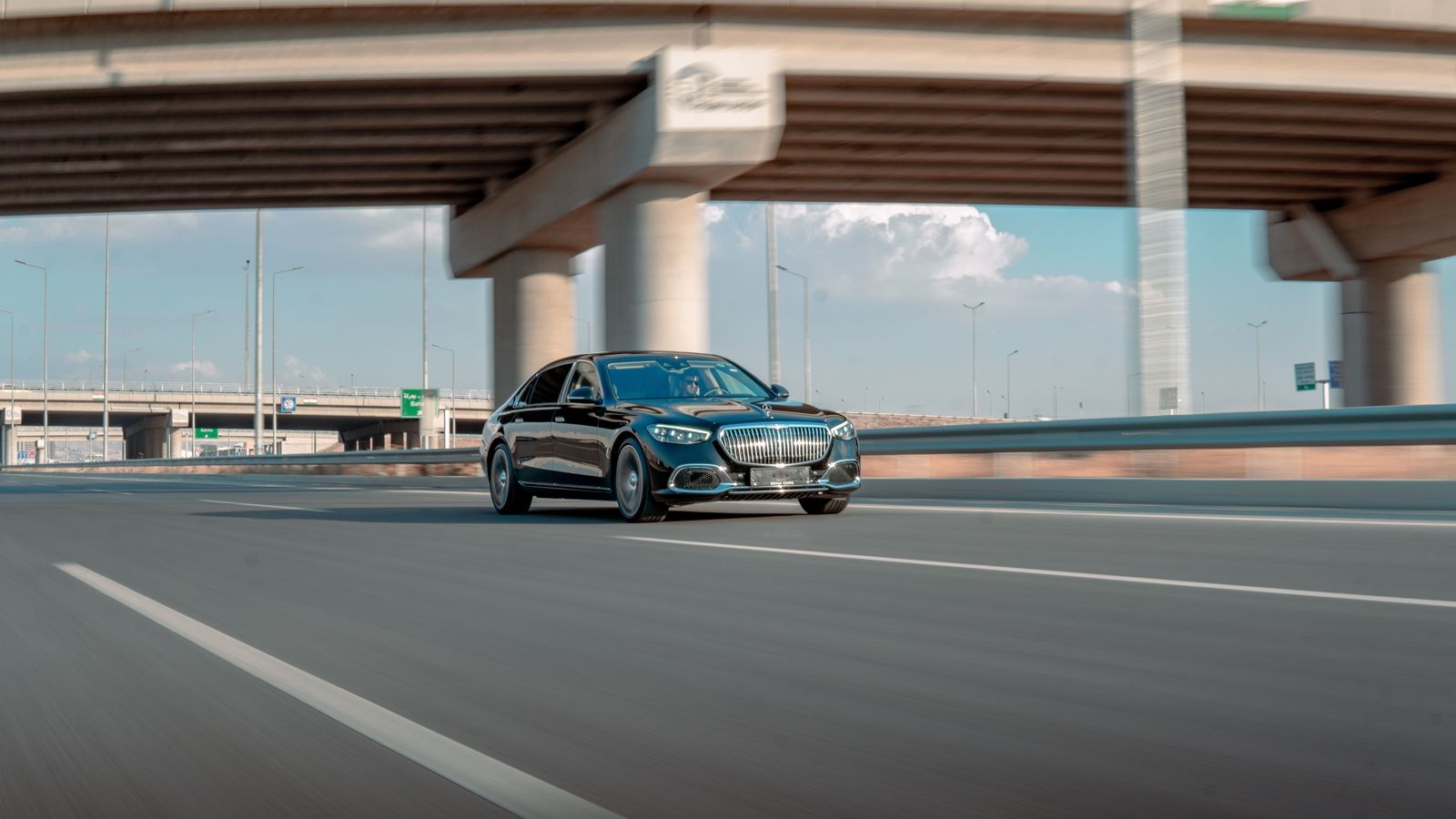
| Business sedan | 3 / 3 | one or two travellers, light luggage | $2,175–2,550 |
| First-class sedan (S-Class / 7 Series) | 3 / 3 | executives who work in the back | about $3,265–3,825 |
| Executive SUV | 6 / 6 | families, extra luggage, winter | about $2,725–3,315 |
| Luxury van | 6 / 6 | families who want easy access | about $2,725–3,315 |
| Sprinter | 14 / 14 | groups, teams, event crews | about $4,785–5,610 |
A stretch limousine is a poor choice for an interstate drive of this length; they are built for evenings, not highways. If you want the stretch for an event in New York itself, that is a local booking through a New York operator.
Step 2: pick the departure time
The best departure from Toronto is early: between 5 and 6 a.m. That clears the QEW before rush hour, meets the border at a quiet time and reaches Manhattan in the early afternoon, ahead of the evening crush at the Hudson crossings.
A late-morning start often meets New Jersey traffic on arrival. An overnight departure is possible and some families prefer it so the children sleep, but tell dispatch at booking so a rested chauffeur is scheduled. Whatever time you choose, the fare is fixed; there is no surcharge for early starts on this route.
Step 3: gather the border documents
Everyone in the car must be admissible to the United States in their own right. Canadian citizens travel on a passport or NEXUS card. Permanent residents and visitors need a valid passport and whichever US entry document applies to their nationality; check the requirements on the US Customs and Border Protection site well before travel.
Tell us at booking if anyone travels on a non-Canadian passport, and whether every passenger holds NEXUS, because a NEXUS lane can only be used when all occupants are members. On the day, keep documents in a bag inside the car, not in the trunk.
Step 4: tell us about stops, food and work
The drive includes two or three short stops for fuel, washrooms and food. You can shape these at booking: a proper sit-down lunch, a stop at a particular place, or as few stops as possible because you want to arrive. Executives often ask for a quiet cabin and a steady connection so they can work; the car has chargers and water, and the chauffeur keeps conversation to a minimum unless you want it.
If you are travelling with children, plan a longer midday stop. Car seats are fitted on request at booking; see our child car seat transfers page.
What happens at the border?
The chauffeur chooses the crossing on the day, using live wait times from the CBP border wait times page. At the booth, the officer speaks to everyone through the windows, looks at documents and may ask about the purpose of the trip and what you are carrying. Occasionally a car is sent to secondary inspection; it is routine and usually quick.
Be ready to say where you are staying and for how long. Do not carry fresh fruit, meat or other restricted goods, and declare anything you are unsure about. The chauffeur handles the vehicle questions.
Arriving in Manhattan: the last hour
The last hour is the slowest part of the trip. The car crosses the Hudson by the George Washington Bridge or the Lincoln Tunnel, both run by the Port Authority of New York and New Jersey, then works through Midtown or downtown traffic to your address.
Hotels in Manhattan have short loading zones and doormen who expect cars to pull in, unload and move on quickly. The chauffeur will stop as close to the door as the street allows, unload bags, and wait while you check in if you want help with luggage. For private residences, give the building's exact entrance and any doorman or loading instructions at booking.
Getting around New York once you are there
Once you are in the city, the Toronto car usually heads home, unless you have booked it to stay with you. For local rides in New York, including trips to JFK, LaGuardia or Newark at the end of your stay, we arrange a licensed New York affiliate. Tell us your plans at booking and we will quote both parts together.
If you are flying home, our post on Toronto Pearson to New York by car or by flight compares the options for the return, and our New York arrivals page covers the Pearson end.
Should the car stay with you, or go home?
For a short visit, one or two nights, keeping the same car and chauffeur can be simpler and sometimes cheaper than two separate one-way trips, because the chauffeur does not drive back empty. The quote then includes the chauffeur's accommodation and meals, and the chauffeur's working hours are planned so the return drive is safe.
For stays of three nights or more, two separate one-way bookings are usually better value. Ask dispatch to price both options; the reservation engine handles the one-way, and dispatch prices the car-stays-with-you option in writing.
Four trips we see often
- A Broadway weekend for four. An SUV leaves Toronto at 6 a.m. on Friday, arrives mid-afternoon; the family flies back Sunday evening from LaGuardia to Pearson and we collect them there.
- University move-in. A parent and student with a car full of belongings drive to a New York campus; the parent flies home the next day.
- An executive roadshow. A first-class sedan collects a CFO in Toronto for a two-day series of investor meetings; local New York cars run the meetings. Our roadshows and investor meetings page covers these.
- A family wedding. A Sprinter takes twelve guests from Toronto to a wedding in the New York area and brings them back two days later.
How far ahead should you book?
For a weekday trip outside holidays, a few days' notice is usually enough. For long weekends, the US Thanksgiving period, the December holidays and March break, book two to three weeks ahead so the right vehicle and a rested chauffeur are secured.
Remember the cancellation rule: free more than 72 hours before pickup; 10 per cent at 72 hours or less; 50 per cent at 48 hours or less; the full fare at 24 hours or less or for a no-show.

Winter and the New York drive
Between December and March, lake-effect snow around Buffalo and the Tug Hill area east of Lake Ontario can slow the Thruway and I-81. Dispatch checks the forecasts and the New York State Thruway conditions before departure and chooses the route accordingly: the Niagara crossings and I-90, or the Thousand Islands crossing and I-81.
In a serious storm, we will call to suggest delaying departure or starting earlier. An SUV is the better winter vehicle on this route, and many families choose it from November onwards.
What does the fare include, and what is extra?
The New York fare covers the chauffeur, the vehicle, fuel, the bridge toll at the border, US highway and river-crossing tolls, and gratuity; HST is shown separately. Food, hotel parking in New York if you ask the car to wait, and any overnight costs when the car stays with you are the main items that can be added, and they are quoted in writing before you confirm.
Waiting beyond the planned stops, or an extra pickup on the way such as collecting a second passenger in Mississauga or Burlington, is priced at booking rather than added afterwards. If your plans change on the day, the chauffeur calls dispatch and you are told the cost before the change is made.
New York to Toronto: booking the trip home
The reverse journey works the same way. If your Toronto car has gone home, we arrange the pickup in New York through a licensed affiliate or send a Toronto car south for the day, depending on dates and cost. Give the exact pickup address and any building access instructions, and allow for Manhattan traffic when choosing the time: leaving before 7 a.m. avoids the worst of it.
Returning Canadians clear the CBSA at the border; have receipts for goods bought in the US ready.
How to book limousine service to New York City
Enter your Toronto pickup address and your New York address in the reservation engine, choose the vehicle and date, and it shows the fixed fare, including fuel, tolls, the border crossing and gratuity, with HST shown separately. Add notes about stops, car seats, extra luggage or local New York cars, and dispatch will confirm the details.
For other US destinations, including Buffalo, Rochester and Detroit, see our cross-border limo to the USA and long distance car service pages.